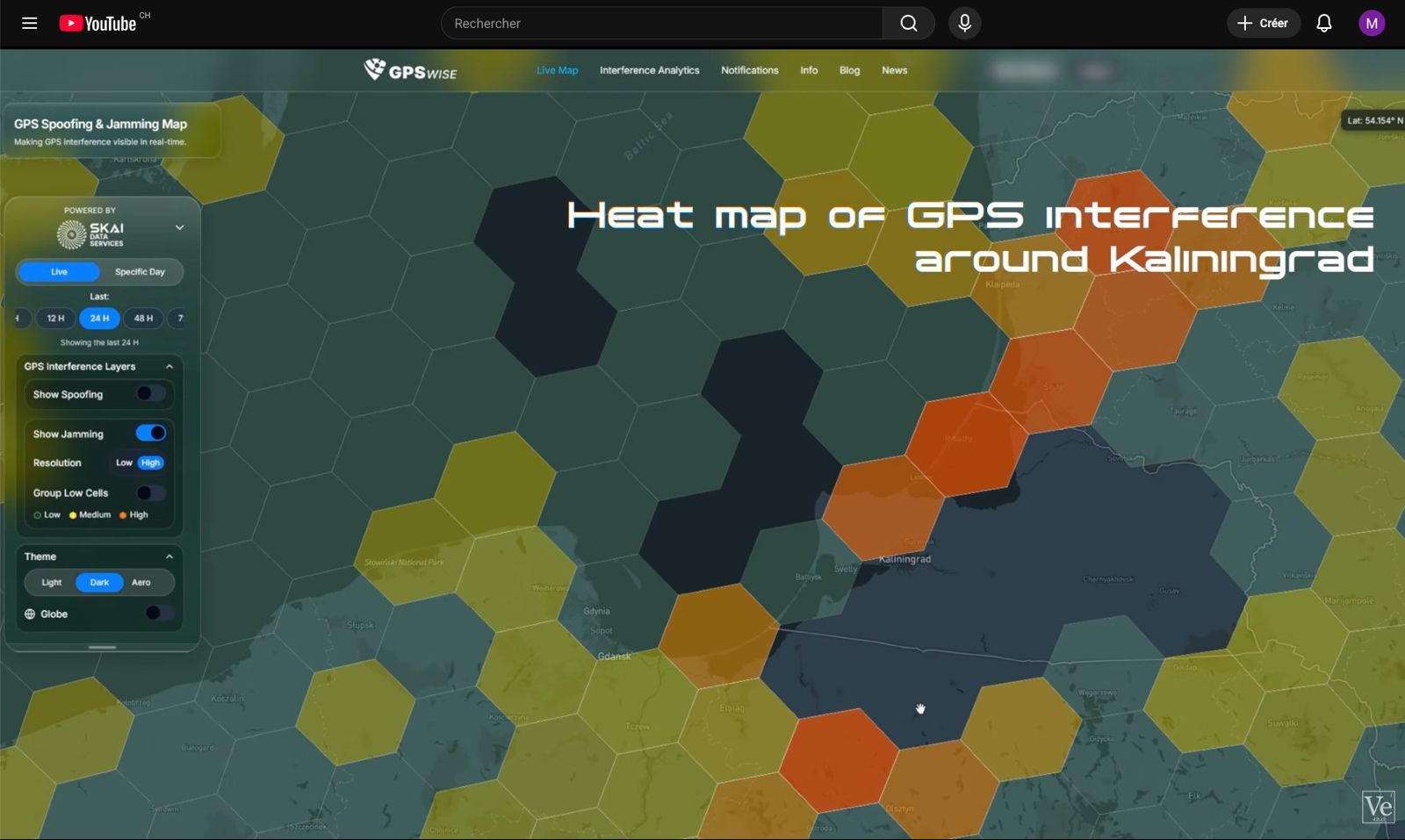
Veritasium has released a new video, Something is jamming GPS over Europe. Here’s what we found, explaining one of the most remarkable GNSS interference investigations of recent years.
The video follows the work of Professor Todd Humphreys, Dr Zach Clements, and their collaborators as they investigate a series of powerful GNSS interference events affecting large geographic areas. Their research, published as Chasing Lightning: Detecting, Characterizing, and Identifying a Powerful Space-Based GNSS Interference Source, analyses events observed between 2019 and 2026 over continental Europe, Greenland, and Canada, and identifies the source as a constellation of Russian early-warning satellites in Molniya orbits.
We were pleased to see GPSwise credited in the video. The Veritasium team used GPSwise software to visualise GPS jamming and spoofing, helping make a complex and largely invisible phenomenon easier to understand.
Why GNSS interference matters
Global Navigation Satellite Systems, including GPS, Galileo, GLONASS, and BeiDou, are essential to modern aviation. They support navigation, surveillance, timing, flight planning, and many operational processes that pilots, dispatchers, air navigation service providers, and regulators rely on every day.
But GNSS signals received on Earth are weak and can be disrupted.
Two forms of interference are particularly important:
- Jamming, where interference prevents a receiver from properly using GNSS signals.
- Spoofing, where false signals can cause a receiver to calculate an incorrect position, time, or altitude.
For aviation, this is no longer a theoretical issue. GNSS interference has become a regular operational concern in several regions, especially near conflict zones and other sensitive areas. It can increase crew workload, degrade navigation and surveillance systems, trigger misleading alerts, and reduce the resilience of normal operations.
Making invisible interference visible
One of the challenges with GNSS interference is that it is not directly visible. Aircraft may experience degraded navigation performance, false positions, or loss of GNSS integrity, but understanding the wider geographic pattern requires data, monitoring, and careful analysis.
This is the purpose of GPSwise.
GPSwise uses aviation data to detect and visualise GPS jamming and spoofing affecting aircraft. The platform provides live maps, alerts, analytics, and API access to help aviation stakeholders understand where GNSS interference is occurring and how it evolves over time.
By turning aircraft-derived signals into operational intelligence, GPSwise helps users move from isolated reports to a more complete picture of the interference environment.
A growing need for GNSS interference awareness
GNSS interference is dynamic. It can appear, disappear, move, intensify, or change character over time. Static reports are useful, but they are not enough for day-to-day operations.
Airlines, ANSPs, airports, regulators, defence organisations, and data service providers increasingly need timely information on GPS jamming and spoofing to support situational awareness, operational planning, safety analysis, and post-event investigation.
This is where real-time monitoring becomes valuable. GPSwise is designed to provide that operational layer: a live, data-driven view of GNSS interference affecting aviation.
Watch the Veritasium video
We strongly recommend watching Veritasium’s video if you are interested in GPS jamming, GPS spoofing, GNSS interference, or aviation resilience.
It is a fascinating investigation and a reminder that GNSS interference is now an operational reality that deserves serious attention, rigorous analysis, and clear communication.