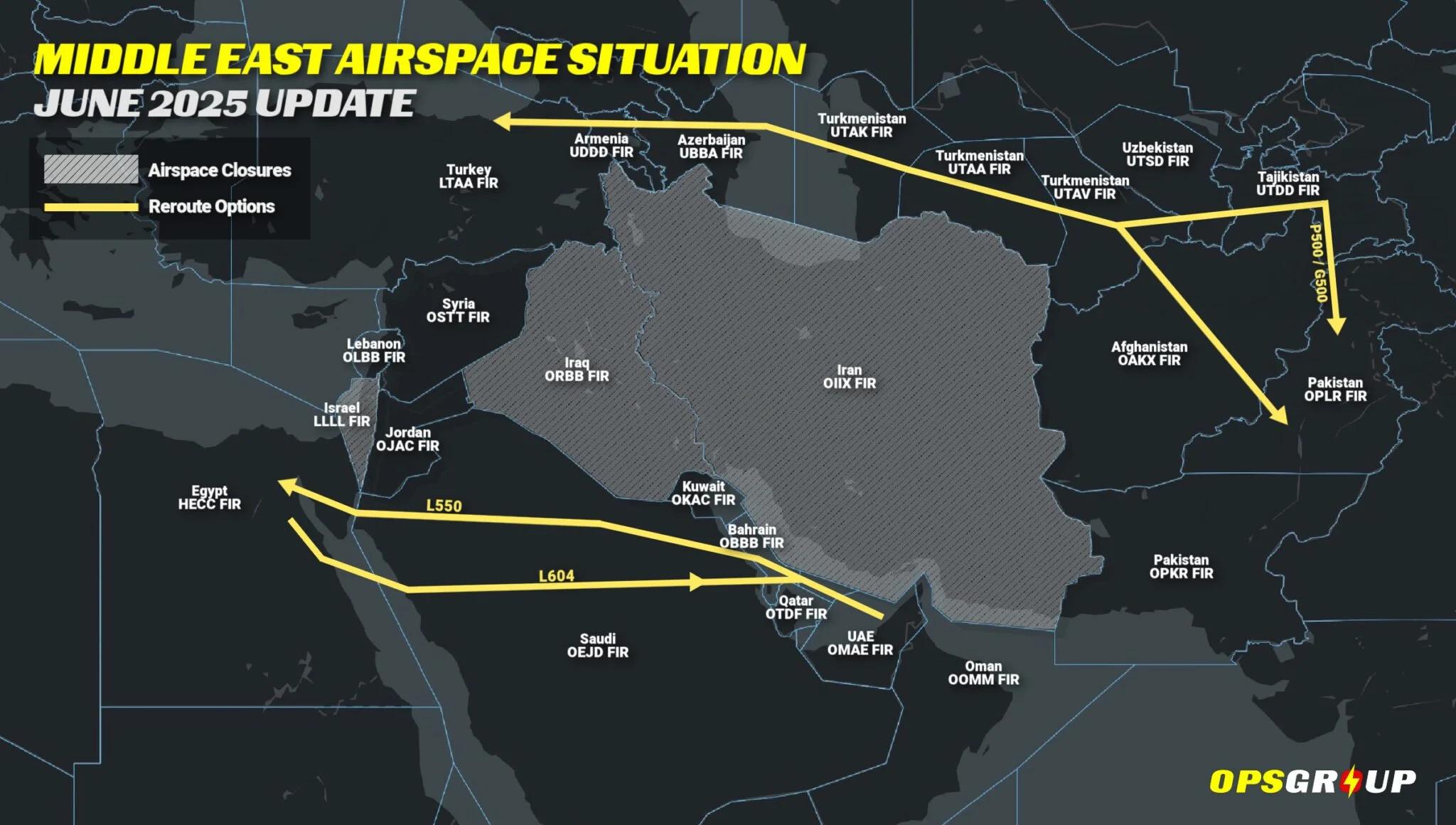
The ongoing conflict between Iran and Israel has significantly disrupted civil aviation, as airspaces over Iran, Iraq, and Israel remain closed.
These airspace closures force the air traffic between Europe and South/South-East Asia into two narrow corridors:
Northern corridor
Via the Caspian Sea and the Black Sea. This corridor is constrained to the south by the Iranian airspace and, for western operators, by Russia to the north.
Southern corridor
Via Saudi Arabia and Egypt. This corridor is limited to the north by the airspace of Iran, Iraq, and Israel.
According to the OpsGroup, this leads to heavy congestion on these two routes, with the risk of overloading these sectors. To make matters worse, both corridors are affected by GPS interference.

The figures above show the GPS interference (spoofing and jamming) on GPSwise (https://gpswise.aero) in the area over the last 72 hours.
This is a significant increase compared to the time before June 13 (the start of the conflict). Before the start of the conflict, we only occasionally observed GPS interference in the Persian Gulf and significantly reduced activity around Israel, now both areas show a lot of interference. The number of affected aircraft also increased somewhat on the northern corridor. However, we assume this is not because of increased interference, but because more air traffic is flying through an area that has a more-or-less constant level of GPS interference.